Covered call லேபிளுடன் இடுகைகளைக் காண்பிக்கிறது. அனைத்து இடுகைகளையும் காண்பி

ஞாயிறு, 24 அக்டோபர், 2021

Should We Short a Put to Help Fund a Collar Trade?

1. Covered call trade + protective put.

2. Collar trade has 3 legs

  • -Long STOCK (buy)
  • -Short call (sell)
  • - Long Put (buy)

3. Should we add a 4th leg by selling PUT as well?

-To fund the protective put.

All traded on 10/9/2018

  • Buy 100 NVDA at 264.24 (now a long stock position)
  • Sell 1x 265 call at 14.45 (now a covered trade)
  • Buy 1x 250 Put at 8.20 (now a collar trade)
  • Sell 1x 245 put for 6.65 (covered call on the upside and bear put spread on the bottom side)


Adding a Short Put to fund the cost of the Long Put: Advantages

  • By generating a premium of $6.65, $8.20 cost of the protective put is reduced to $1.55
  • The initial calculations then became:                                                                                 -14.45 - 1.555 = $12.90 = 4.9% ( on a cost basis of $264.24)
  • This is more than double the collar initial time value return

Adding a Short Put to fund the cost of the Long Put: Disadvantages

  • By selling the deeper OTM put (245.00 strike) we are  incurring additional risk to the downside. 
  • If the price moves below 245.00 strike, we start losing money on that leg of the trade as the strike now is in ITM and has an intrinsic value component.
  • That risk can be quantified in a worst case scenario a follows:-            
  • 245-6.65 = 238.35 per share
  • Of course we would take exit strategy steps before letting the trade get that far out of control, but the risk should be understood and qualified before entering the trade.

  • Discussion
  • When establishing our covered call positions ,  we must define3 our personal risk-tolerance and set up our trades accordingly.. 
  • If we require additional protection to the downsize, a protective put is a reasonable approach.
  • Like most insurance policies, we must pay for this protection and our initial results will then decline.
  • If a short put added to mitigate the cost of Long put, we 2ill then be adding additional risk which is what we were trying to avoid by buying the protective put.
 * https://www.youtube.com/watch?v=TcF12X4uljg&t=435s 

புதன், 20 அக்டோபர், 2021

Explaining “Bought-Up” Value When Rolling a Covered Call Out-And-Up

 We can roll out to the same strike at a later date or out-and-up to a higher strike at a later date. For both, there will be an intrinsic-value cost-to-close. When we roll out-and-up, we will benefit from share value being worth more than prior to closing the original short call. In our BCI methodology, this gain is referred to as bought-up value. This article will detail all the explanatory calculations.

Hypothetical trade

  • 5/24/2021: Buy 100 x BCI at $48.00.
  • 5/24/2021: STO (sell-to-open) 6/18/2021 $50.00 call at $1.50.
  • 6/18/2021: BCI is trading at $52.00 as expiration approaches.
  • 6/18/2021: BTC (buy-to-close) the 6/18/2021 $50.00 call at $2.10 ($2.00 intrinsic-value + $0.10 time-value).
  • 6/18/2021: STO the 7/16/2021 $55.00 call at $1.00 (rolling-out-and-up).

Initial trade structuring (multiple tab of the Ellman Calculator)

BCI - initial calculations

The initial time-value return is 3.1% (yellow cell) with the possibility of an additional 4.2% of upside potential (brown cell) if BCI moves up to or above the $50.00 strike by expiration. As long as the contract obligation to sell at $50.00 is in place, our shares cannot be worth more than $50.00. This is how the trade is structured.

Rolling-out-and-up: information into the “What Now” tab of the BCI Calculators 


Rolling-Out-And-Up Data Entries

Rolling-out-and-up: final calculations from the “What Now” tab of the Ellman Calculators 

BCI: Rolling-Out-And-Up Final Calculations

BCI: Rolling-Out-And-Up Final Calculations

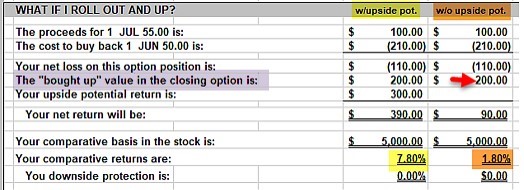
The bought-up value is $2.00 per share or $200.00 per-contract. This is because shares can only be worth $50.00 with the original short call in place, but once the short call is closed, shares are worth market value of $52.00. This bought-up value must be incorporated into our calculations since we paid for it in the form of intrinsic-value cost-to-close.

The final calculations show an initial time value + bought-up value combined return of 1.8% (brown cell). If share price moves up to the new out-of-the-money $55.00 strike by expiration (an additional $3.00 per-share), the total one-month return will be 7.80% (Yellow cell).

Discussion

When rolling an ITM strike out-and-up, there will be an intrinsic-value cost-to-close. There will also be an unrealized increase in share value by that intrinsic value amount. In the BCI methodology, this is known as bought-up value and must be incorporated into our rolling calculations.


வெள்ளி, 18 ஜூன், 2021

The Math of Unwinding Covered Call Writing Trades Early


j


https://www.moneyshow.com//articles/tradingidea-56792/the-math-of-unwinding-covered-call-writing-trades-early/?scode=015363&utm_campaign=Trading%20Insights%20-%20Daily&utm_medium=email&_hsmi=134467472&_hsenc=p2ANqtz-8OHdNbwgzMSmxciYjNcvIP-yarWVQKVtYmAuh9ozdNpkF3zmWYbxP64FgGA_UDeayfYGwZOhTzq-CGDH1ysVrLz9wIuw&utm_content=134467472&utm_source=hs_email

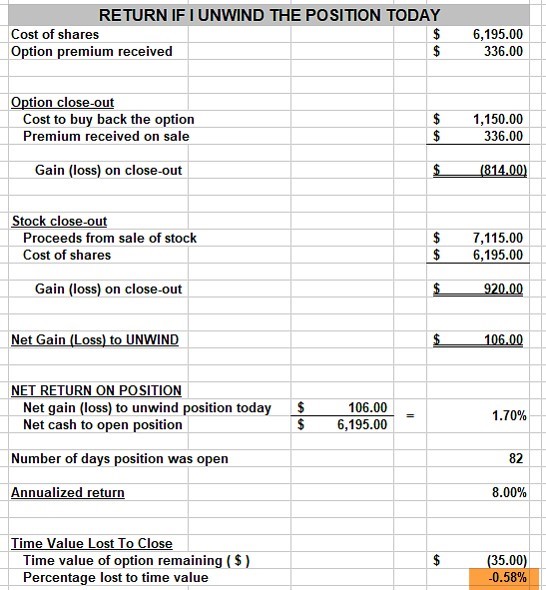
Unwind calculations if both legs of the position are closed on 10/6/2020

Unwind calculations if both legs of the position are closed on 10/6/2020


The time-value cost-to-close (CTC) is 0.58%. There are 10 days remaining to contract expiration. We ask ourselves: Can we generate at least 1% more than the time-value CTC or 1.58% or more with a different security by 10/16/2020? If yes, we execute the mid-contract unwind exit strategy. If no or unsure, we take no action and continue to monitor the trade with possible rolling opportunities as expiration approaches.

Discussion

Exit strategy opportunities must be executed when beneficial to our overall portfolio success. To make these determinations, the BCI Calculators will assist as the formulas are built in to allow us to understand the mathematics of our trades. In the case of Alex’s TAN trade, a successful trade was executed with the possibility of establishing a second income stream in the same contract month with the same cash investment. 


IBD information to Buy to Sell etc

 எhttps://www.investors.com/how-to-invest/when-to-sell-stocks/   When to sell stocks. https://www.investors.com/how-to-invest/how-to-buy-sto...